01
Context
Tourlane helps users plan and book fully personalised, multi-stop itineraries with the guidance of dedicated travel experts (sales agents).
The primary mode of acquisition was via an initial video or phone call. Customers could schedule a call directly, or receive a short introductory pre-sales call from Tourlane once they had created a travel request.
02
Problem
While calls had proven to build relationships and trust with our users, it was also proving to be an inefficient and limiting mode of communication early in the acquisition funnel.
How might we introduce a new mode of communication in order to improve acquisition and sales efficiency?
03
Discovery
I went in knowing the business goals: improve first call conversion rate and reduce time agents spent per lead. The project focus was clear: explore asynchronous or digital communication channels as an alternative to calls.
What I didn't yet know: which moments in the user journey to focus on, which channels would suit each use case, and what actually happens during pre-sales and first calls: the conversation patterns, friction points, and pain points on both the user and agent side.
Research
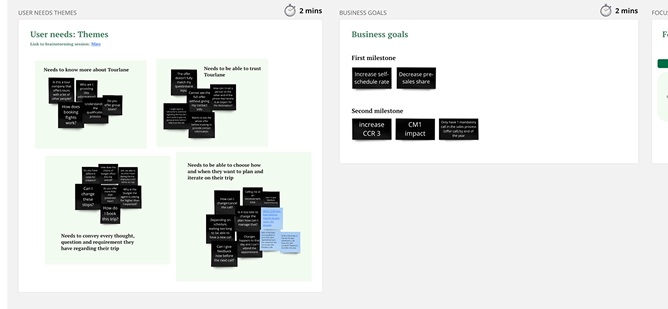
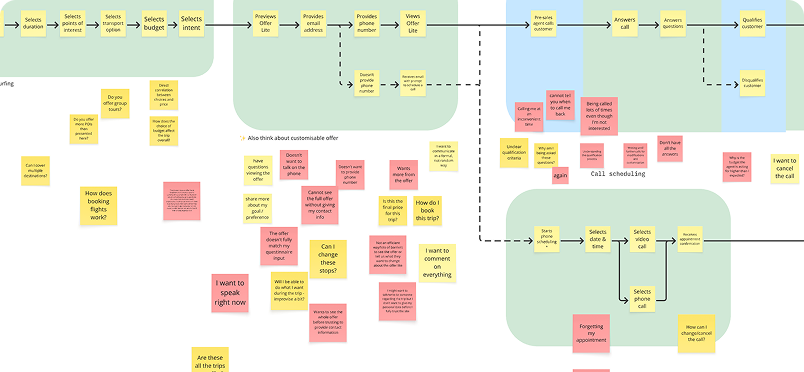
Agent interviews: Interviewed 3 sales agents and 2 team leads, using a journey-based framework to uncover frustrations and patterns across call touchpoints. Synthesised findings through an affinity map to identify key insights.
Analysed customer support requests and attempts to contact us through alternative communication channels.
Quantitative data analysis: Reviewed call-related statistics to assess patterns, drops in the user journey, and most impacted metrics.
Insights
Customers are often caught off guard and frustrated by unexpected pre-sales calls
This suggests a potential lack of trust and a feeling of lost control over a very personal travel planning process. Many users also fear unknowingly or forcefully "entering a process".
Customers typically have many questions during the early stages of the journey
Uncertainty and hesitance is usually prominent when users are interacting with Tourlane for the first time, and there's a pattern of curiosity to understand the service in order to build trust.
Customers frequently request to continue conversations through SMS or email rather than calls
This supports our assumption that many users are apprehensive about phone communication.
Agents avoid email communication due to its slow response times
While users prefer email, agents avoid it due to its slower response times which can hinder sales efficiency.
A pre-sales qualification process produces higher quality leads
Without it, poor-quality leads and no-shows occupy agents' schedules, reducing the time available to convert higher-potential leads.
04
Ideation
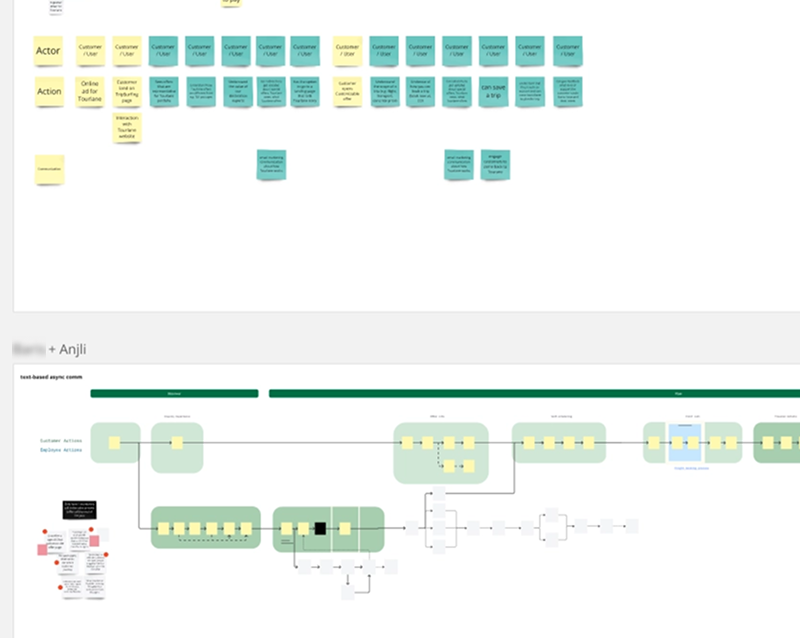
With the insights gained from the research, I conducted workshops with adjacent Product teams and Sales Leads to explore opportunities and brainstorm solutions, and also to understand the potential impact of these solutions across other Product areas and departments.
Top 3 ideas:
1-on-1 text-based communication
Enable personalised, direct communication between users and agents through asynchronous texting modes.
Chatbot for answering early questions
Provide instant, automated responses to common user inquiries.
Feedback and questions on the Trip Proposal page
Add functionality on the Trip Proposal page to allow users to ask questions and give feedback on the proposal directly.
Defining scope
In order to further narrow down on scope, I explored a combination of chatbot and live chat flows within different use cases in the top funnel. This also helped facilitate strategy and decision making with leadership and operational stakeholders.
Given the existing sales ecosystem of tools and processes, implementing a 1-on-1 chat-based communication mode, early in the funnel, appeared to be the most achievable first step for an MVP.
05
MVP
Test lead qualification via WhatsApp chat with a small, dedicated team of pre-sales agents.
- Pre-qualified leads generally converted better during first calls, which made lead qualification a suitable area to test a new mode of communication on.
- WhatsApp is a widely used tool, particularly in the DACH region, and has increasingly common usage within the travel tech industry.
- The existing communication infrastructure with Twilio supported WhatsApp integration, making it a quick, cost-effective and easy-to-implement solution.
Design and development
With a third-party tool handling the interface, I focused the design effort on the service layer. This meant defining user, agent, and system flows, mapping automation touchpoints, and scripting conversation templates to ensure the experience held quality end-to-end.
Service design proposal
Worked out each use case and edge case closely with engineers
Mapped where automations and live communication should intersect
06
A/B Testing
Experiment #1
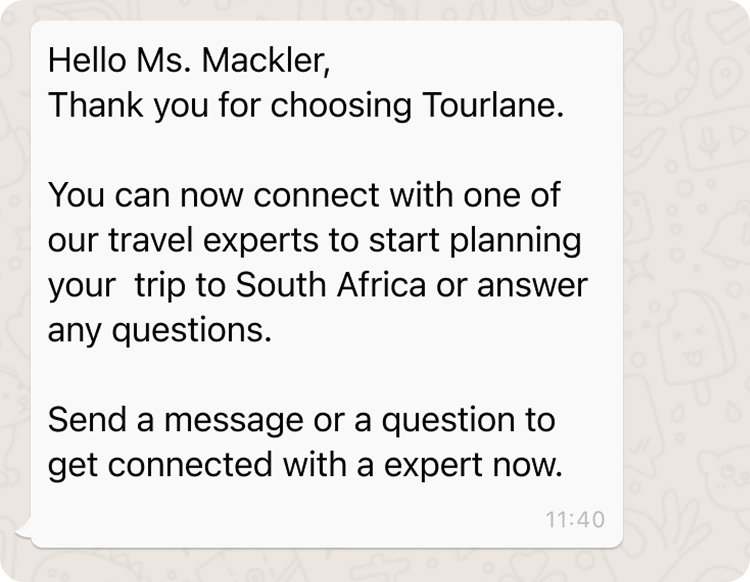
To reduce dependency on other teams, and to enable faster development and release, we tested a "cold messaging" concept: users who shared their phone numbers during sign-up would receive an automated WhatsApp message from Tourlane to connect them to an agent.
Hypothesis
Introducing WhatsApp as an additional mode of communication could help engage and convert users who are apprehensive about the service or phone calls, as well as help agents be more efficient in filtering low-intent leads.
Goals
- Test engagement rate of WhatsApp as a communication channel
- Observe changes to first call conversion rate
- Observe common patterns and user needs in conversations
Results
24.6% drop in first call conversion rate
Rate of overall first calls scheduled severely dropped compared to the control group.
Engagement rate at 10.8%
A small amount of users did initiate a conversation in response to the cold message they received.
Conversion was high among users who engaged
Among users who engaged via WhatsApp, first call conversion was higher with an uplift of 111% compared to users in the control group.
Patterns in conversation
- Most users who engaged to learn more about Tourlane or their trip eventually scheduled a first call.
- While users had many questions, conversations were largely agent-driven and lacked a sense of engagement or two-way flow.
Experiment #2
In this iteration, users could opt in to WhatsApp communication while entering their phone number during sign-up, using a simple checkbox. This triggered an automated message encouraging them to either schedule a call or connect with an agent for questions.
Hypothesis
- Contacting users without explicit consent may have reduced their trust in the brand, deterring them from continuing through the funnel, causing low engagement and conversion.
- Consent might help filter higher-intent users into the pre-sales funnel, increasing a possibility in overall conversion.
Goals
- Improve WhatsApp engagement rate.
- Improve first call conversion rate.
Results
No significant change in first call conversion rate
Rate of first calls scheduled did not see a drop, but also didn't show any improvement compared to the control group. This indicated stabilisation from the previous experiment.
Engagement rate improved from 10.8% to 27.2%
Compared to the previous experiment, more users opted in and engaged through the WhatsApp channel, indicating an opt-in approach is better received than cold messaging.
Improved conversion rate in engaged users by 4%
Compared to the previous experiment, there was a small uplift of first call conversions among users who engaged via WhatsApp. This indicated potential filtering of higher-intent users.
Experiment #3
In this iteration, users could:
- Opt in to WhatsApp communication during sign-up, or
- Initiate a WhatsApp conversation after viewing their trip proposal, through contextually placed prompts on the proposal page.
Hypothesis
- Engagement may improve if users can first view their trip proposal before being prompted to connect.
- Contextual prompts within the trip proposal, shown at the end of an itinerary or along with the FAQs, could encourage users to utilise this channel.
Goals
- Improve opt-in and engagement rate.
- Improve first call conversion rate.
Results
Development of this test and the overall project was paused due to business reprioritisation.
07
Reflections
Introducing a new communication channel without restructuring the funnel and messaging around it created new friction rather than removing existing friction.
- Consent drives engagement and trust. Customers who opted in actively were significantly more likely to interact than those messaged without prior consent.
- Context is key. Prompts tied to a specific moment in the user journey, e.g. after viewing their trip proposal, had stronger potential to spark meaningful conversation than generic outreach.